Here’s something you don’t hear from a plumber every day: there’s a category of pipe replacement you almost certainly should not hire me for.
If your home has a lead or galvanized water service line — the pipe running from the water main in the street to your meter — New Jersey law requires your water utility to replace it by 2031, and in most of Mercer County that replacement happens at no cost to you.
Homeowners who pay a contractor out of pocket for work the utility is legally obligated to do are spending thousands they don’t need to spend.
But the law only covers the service line. Everything on your side of the meter — and everything lead-era inside your walls — is still yours. This guide covers both halves: what the program handles, how to check what you have in about five minutes, and where a plumber’s work genuinely begins.
What a Service Line Is (and Who Owns It)
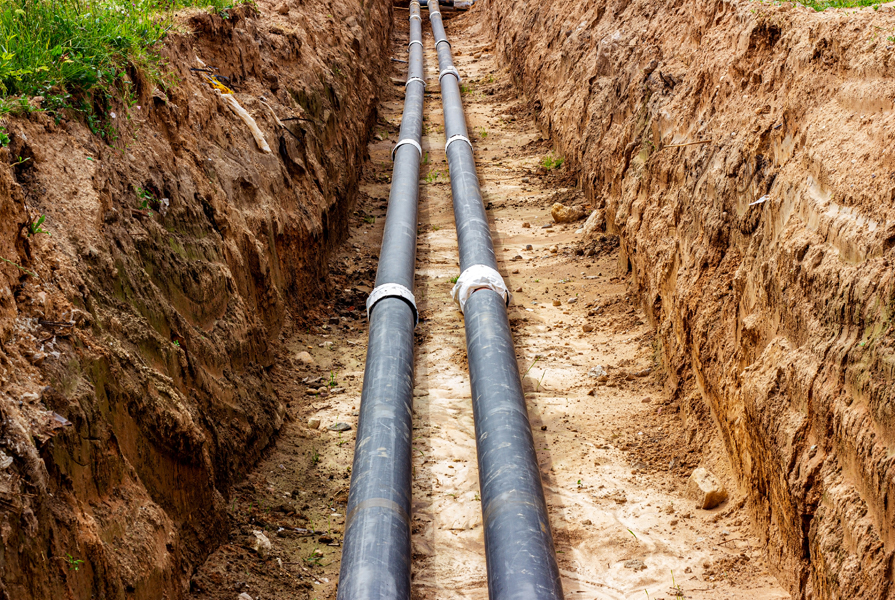
A service line is the underground pipe connecting the water main under your street to your home. Historically, ownership was split: the utility owned the stretch from the main to the curb stop, and the homeowner owned the stretch from the curb to the meter. That split is exactly why lead lines lasted so long — utilities replaced their half and left the private half in the ground, and partial replacements can actually disturb a lead pipe enough to temporarily increase lead levels.
New Jersey ended that arrangement. The 2021 state law (P.L. 2021, c.183) requires water systems to identify, disclose, and replace all lead service lines by 2031 — both the utility-owned and customer-owned portions. And under New Jersey’s definition, “lead service line” includes more than pure lead pipe: galvanized service lines count too (galvanized steel absorbs lead particles shed from upstream lead components), as does any line with a lead gooseneck or pigtail fitting, regardless of what the rest of the pipe is made of.
Why Mercer County Has So Many Lead Lines
Lead was the standard service line material for American cities from the late 1800s into the mid-20th century — it was durable, easy to bend around obstacles, and, ironically, considered the premium choice. Any neighborhood built during that window likely got lead lines as original equipment, and Mercer County built a lot of neighborhoods during that window: 45 percent of Trenton’s housing predates 1950, nearly three in ten Ewing homes do, and every town in the county has a pre-war core.
There’s a local twist to the story, too. Trenton wasn’t just plumbed in that era — Trenton made plumbing in that era. The city’s potteries turned out the nation’s sanitary ware, and its mills and foundries supplied the building trades up and down the East Coast. The housing that grew around those factories got the standard materials of its day: lead and galvanized service lines outside, galvanized supply pipe and cast-iron stacks inside.
Statewide, the scale is why the law exists: New Jersey has an estimated 350,000 lead service lines, and Trenton Water Works alone began its program with an inventory of more than 31,000 across its five municipalities. Lead solder in copper plumbing wasn’t banned federally until 1986 — which is why even homes decades younger than the lead-pipe era can carry lead at the joints.
A Word on Why This Matters — Without the Alarm
The public-health case is settled and worth stating plainly, once: there is no known safe level of lead exposure, corrosion inside a lead pipe can release lead into the water that sits in it, and young children and pregnant women are the most vulnerable. That’s why NJDEP calls lead service lines a significant source of lead in residential drinking water, and it’s why the state’s response is structural — replace the pipes — rather than advisory.
What that doesn’t mean is that every home with a lead line has a water crisis. Utilities treat water to control corrosion, testing exists, certified filtration exists, and the replacement program is running. The right posture for a homeowner is neither panic nor shrug: find out what you have, get in the program’s queue if it applies to you, and take the interim measures below if it does. The rest of this guide is exactly that checklist.
How to Check What You Have — Two Ways
First: look up your address
If you’re in Trenton Water Works territory — Trenton and parts of Hamilton, Ewing, Lawrence, and Hopewell Townships — TWW maintains a public inventory at twwleadprogram.com. Enter your address to see what the utility has on record for your property, and if the record is wrong or blank, the site’s self-survey tool lets you upload photos of your own line to correct it.
If you’re served by New Jersey American Water — Princeton, West Windsor, and parts of Hopewell and Lawrence — NJAW is running its own statewide identification and replacement program toward the same 2031 deadline, and water systems are required to notify you by mail if your line is recorded as lead, galvanized, or unknown. If you’ve received one of those notices, that’s the program working — not junk mail.
Second: the five-minute test at your meter
The state DEP publishes a simple homeowner method, and it takes a coin, a key, and a refrigerator magnet:
-
- Find your water meter. Usually in the basement, crawlspace, or garage; the service line is the pipe coming through the wall or floor to meet it.
- Test the pipe between the wall and the meter. If it’s painted, expose a small patch of bare metal first.
- Try the magnet. If it sticks firmly, you have galvanized steel — which New Jersey treats as a lead service line, replaceable under the same program. A magnet won’t stick to lead, copper, or plastic.
- Scratch gently with a coin or key. Lead is soft and scratches easily to a shiny silver color. Copper scratches to a bright-penny color. Galvanized stays dull gray. Plastic is plastic — white, black, or colored, and no scratch test needed.
One caveat worth knowing: a copper or plastic line can still have a lead gooseneck — a short flexible lead fitting at the connection — which also counts as a lead service line under state law. That’s part of why the utility inventories matter even when your basement pipe looks fine.
What Happens When Your Line Is Replaced
In TWW territory, the program is real and running: since 2019 the utility has replaced more than 11,000 lead service lines at no cost to property owners, contractors are actively going door to door in the current phases inviting homeowners to sign up, and in the city of Trenton, City Council went a step further — replacement there is free and mandatory under local ordinance.
What replacement day actually looks like
Homeowner hesitation is one of the program’s real bottlenecks, so it’s worth demystifying. When your street’s phase arrives, the contractor canvasses the neighborhood — knocking on doors, verifying service line materials, and signing residents up; if you’re not home, they leave a door hanger with sign-up instructions. The work itself typically runs about a day for a standard replacement: the crew excavates at the curb and at the house (modern methods keep the digging far smaller than homeowners fear), pulls the old lead or galvanized line, installs new copper from the main connection to your meter, restores water service, and backfills. You’ll need to provide interior access at the meter for the final connection — that access is the entire reason for the door-knocking, and granting it is the one thing the program needs from you. The new line is copper, the cost in the current TWW phases is nothing, and the utility restores the disturbed surfaces afterward.
The town-by-town picture at the program’s inventory tells you roughly where you stand: Trenton had about 17,500 lead services, Hamilton about 11,600, Ewing about 5,200, and Lawrence about 2,400 — while Hopewell had zero, because the housing TWW serves there is newer than the lead era. West Windsor and most of Princeton’s newer neighborhoods are similarly clean for the same reason; where lead lines survive in NJAW territory, it’s the pre-war village cores, and NJAW’s program covers both the utility- and customer-owned portions.
The honest caveat: the 2031 deadline is a legal requirement, not a promise about your street’s date. Phases depend on funding, and nobody — including your plumber — should guarantee you a timeline. If your line is confirmed lead and your street hasn’t been scheduled, sign up with the program, and consider the interim measures below.
Where the Program Stops — and a Plumber’s Work Begins
Everything above is the utility’s job. Here’s what isn’t:
Interior galvanized supply piping. The program replaces the line to your meter. If your home was plumbed in galvanized steel — standard in houses built before roughly 1950, which describes most of Trenton, much of Ewing, and the older cores of every town we serve — the pipes past the meter are yours, they’re corroding shut on the same schedule as the service line was, and replacing them is whole-home repiping, which is squarely a plumber’s job.
Lead solder and lead-era fittings. Copper installed before 1986 was commonly joined with lead solder, and older brass fixtures can contain lead. A service line replacement doesn’t touch either.
Filtration while you wait. If your line is confirmed or suspected lead and your street’s phase hasn’t arrived, a point-of-use or point-of-entry filtration system certified for lead reduction (look for NSF/ANSI 53 certification for lead) is the recognized bridge measure. We size and install these matched to what’s actually in your water — testing first, equipment second.
The cleanup after replacement. Swapping a service line disturbs decades of sediment and scale. When your new line goes into service, run the cold-water taps — starting at the lowest level of the house — for several minutes until the water runs clear, and expect some temporary cloudiness or discoloration; that’s dislodged sediment, not a defect. Afterward, aerators on faucets should be removed and cleaned (that’s where particles collect first), and it’s worth having the water heater checked and flushed, since whatever the replacement stirred up settles in the tank and works on the elements. It’s a small visit that protects the equipment downstream of your brand-new line.
If You Rent — or Own Rentals
Tenants have more standing here than most realize. Water systems are required to notify residents — not just owners — when a service line is recorded as lead, galvanized, or unknown, so a notice addressed to “resident” is yours to open and act on. You can check the TWW inventory for your address yourself, and in Trenton the ordinance makes replacement mandatory, which means a landlord can’t simply decline the program.
For landlords, the calculus is simple: the service line replacement costs you nothing in TWW territory, refusing access just leaves a liability in the ground under a property you own, and the adjacent obligations are already on your books — in Hopewell Township, for example, landlords on private wells must test the water every five years and share results with tenants, and Trenton rentals answer to the city’s housing-code inspections separately from construction permits. If you own older rental stock anywhere in the county, the efficient move is one pass: confirm the service line status for every property in the inventory, grant access when the phase arrives, and have the interior galvanized assessed at the same time — because tenant complaints about pressure and rusty water don’t end when the street-side pipe is new.
On a Private Well? Different Rules Entirely
The 2031 law and the utility programs cover community water systems — if your home draws from a private well, as many rural Hopewell Valley properties do, there is no utility and no replacement program, and the water system is yours to manage. Lead can still enter well water from the home’s own plumbing: older pumps and fittings, pre-1986 solder, and brass components. That’s why Hopewell Township’s guidance recommends testing well water for lead every five years alongside arsenic, iron, and manganese, and why New Jersey’s Private Well Testing Act requires a full test whenever a well property changes hands. For well households, the playbook is the same testing-first logic as everywhere else in this guide, with one difference: the results drive treatment equipment you own, not a program you wait for.
The Short Version
Check your address in your utility’s inventory, or spend five minutes at your meter with a magnet and a coin. If the line is lead or galvanized, the replacement is the utility’s legal obligation by 2031 — free in TWW territory, covered under NJAW’s program, and mandatory in Trenton — so don’t pay a contractor for it. What’s yours is everything past the meter: interior galvanized, pre-1986 solder, interim filtration, and the flush-out after the new line goes in. That’s where we come in, across our Mercer County service area — and if you’re not sure which side of the line your problem sits on, call us at (973) 932-2368 and we’ll tell you honestly, even when the answer is “don’t hire us for that.”
Quick Answers
How do I know if my house is old enough to worry?
Built before 1950: lead or galvanized service lines and interior galvanized piping were standard — check. Built 1950–1986: the service line is less likely lead, but copper of that era carries lead solder at the joints. Built after 1986: the lead-pipe and lead-solder eras are behind you, though older fixtures can still contain lead. When in doubt, the five-minute meter test settles the service line question for free.
Is galvanized really treated the same as lead?
Under New Jersey law, yes — a galvanized service line is defined as a lead service line and is replaced under the same program, because galvanized steel accumulates lead shed from upstream lead components even after those components are gone.
The utility’s inventory says my line is “unknown.” Now what?
Unknown means the utility has no record either way — it doesn’t mean you’re clear. Do the meter test yourself, and if you’re in TWW territory, upload photos through the self-survey tool at twwleadprogram.com so the inventory gets corrected. Lines that stay “unknown” are treated as potential lead and stay in the replacement queue, so identifying yours can only speed things up.
Should I get my water tested for lead?
If your line is confirmed or suspected lead, or your home predates 1986 and you’ve never tested: it’s cheap certainty. Use a state-certified lab (NJDEP publishes the list), draw the sample first thing in the morning before any water runs, and test at the kitchen tap. A result in hand also tells you whether interim filtration is worth installing while you wait for your street’s phase.
Will replacing my service line fix my low water pressure?
Sometimes — a corroded galvanized service line does choke flow. But in most pre-1950 homes the interior galvanized is corroding on the same schedule, so pressure often stays low until the inside piping is addressed too. That’s the honest reason to have the interior assessed when the service line is replaced: one diagnosis, and you’ll know whether the new line finished the job or started it.
Can I just have a plumber replace my lead service line now instead of waiting? You can — it’s your property, and for a confirmed lead line with a long wait, or a line that’s actively failing, it’s sometimes the right call. But go in knowing the utility is legally obligated to do it free by 2031, so paying out of pocket is buying time, not something you couldn’t otherwise get. We’ll tell you which situation you’re in before any work is quoted.
Sources
-
- New Jersey lead service line law — identification, notification, and replacement of all lead service lines by 2031; galvanized lines and lead goosenecks/pigtails defined as lead service lines (P.L. 2021, c.183) — NJDEP, Lead Service Line Replacement Requirements
-
- TWW Lead Service Line Replacement Program — inventory lookup, self-survey photo tool, phase progress, replacements at no cost, Trenton’s free-and-mandatory ordinances — twwleadprogram.com
-
- Current TWW phases and door-to-door contractor canvassing in Trenton, Ewing, and Lawrence — Trenton Water Works
-
- Per-municipality lead service counts at program inventory (Trenton 17,463; Hamilton 11,618; Ewing 5,236; Lawrence 2,383; Hopewell zero) — Community News
-
- NJAW commitment to replacing all utility- and customer-owned lead and galvanized service lines by 2031 — New Jersey American Water